What Is a Smile? Why We Smile and How It Impacts Our Mental Health
Most people do not realise when they are smiling. It usually happens fast and without any thought. But your face always has a reason. The muscles are doing something because your brain is responding to something. It could be a moment of relief. Or it could be a habit.
That one movement plays a small but powerful role in how the brain handles emotional signals. The act looks basic, but the feedback loop is real. The muscles in your face tell your brain how to respond.
The psychology of smiling has nothing to do with forced positivity. It is about how body signals affect internal states. How smiling affects mood depends on what kind of smile it is and where it comes from.
The team at HULM Training & Development Pvt Ltd works with clients on emotional patterns like this. You are not taught to smile. You are taught to pay attention to what your body is saying.
One expression does not always mean one thing:
Not every smile reflects the same emotion. People smile when they are happy, but also when they are nervous. They smile when they are uncomfortable. They smile when they do not know what else to do.
There are types of smiles your body learns through experience. Some are full and real. Others feel polite or flat. Sometimes people smile without feeling much at all. It becomes a social habit.
This is something therapy often brings into focus. When you walk into a room, and your face is saying something different from what you feel inside, you start noticing the gap. Facial expressions and mental health are linked in ways most people do not realise until they stop working the way they used to.
When your therapist at HULM starts to notice when you smile and when you do not, it is not to correct you. It is to help you understand how emotional signals may have shifted under stress.
Smiling sends a message, but it also starts a cycle:
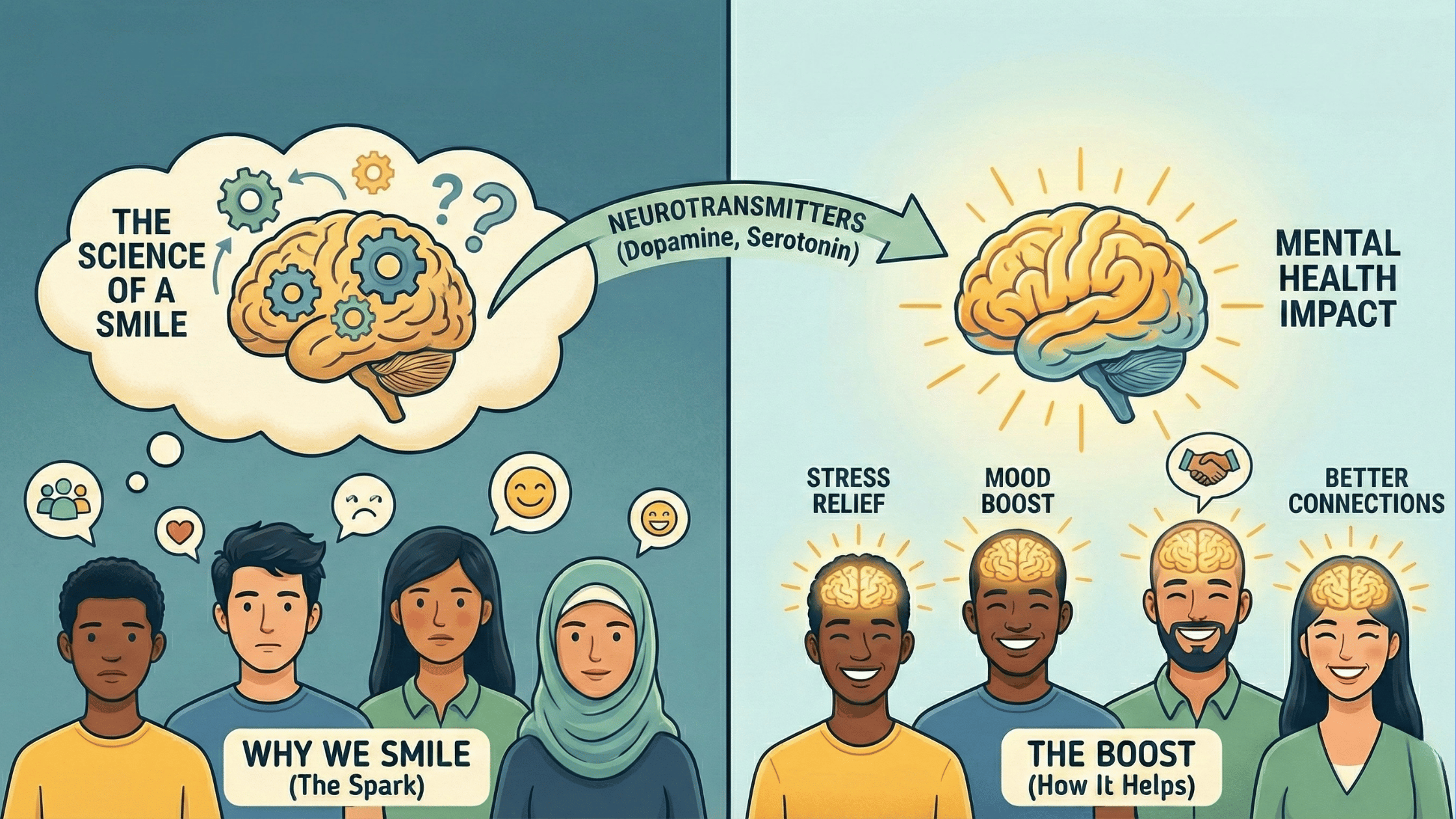
Your mind hearkens to what your body is saying. When you smile, your face sends messages using the nerves that everything may be alright. The brain, in turn, reacts with corresponding chemicals.
Here is how that looks inside the body:
-
When you smile, the brain releases small amounts of dopamine and serotonin. These chemicals reduce stress.
-
Endorphins also show up. These create small signals of comfort that help reduce emotional reactivity.
-
The muscles in your face send feedback to the brain to reinforce the current state.
The benefits of smiling are not based on pretending. They are based on physical signals that start a mental shift. The smile does not have to feel joyful. It just needs to happen in connection with something that feels safe or steady.
Smiling and mental health are not separate topics. They work together through feedback loops that most people never learn to notice. Smile stress relief does not come from acting happy. It comes from staying present in your body.
If smiling feels harder than usual, that often means something:
There are phases in life where even the idea of smiling feels strange. It is not sadness. It is something heavier. Your body does not want to respond.
People in therapy often say the same thing. “I don’t remember the last time I smiled without faking it.” What they are describing is emotional shutdown. The signals are still happening, but the expression does not follow. That usually means fatigue.
Here are signs this might be happening:
-
You force a smile in front of others but feel blank when alone.
-
You notice that your body feels disconnected even during light or happy moments.
-
You avoid conversations because you feel like you have nothing left to show.
Emotional exhaustion in Bangalore is rising across all age groups. These are not just moods. These are patterns the body builds to protect itself. Mental health signs you can see often appear before you can explain them.
Therapists at HULM are trained to notice when emotional energy no longer reaches the face. That is often where the deeper work begins.
The goal is not to make you smile. It is to help you feel again:
Therapy is not about fixing your face. It is about helping you recognise what is happening under the surface. When someone stops smiling for long stretches, it usually means the body is trying to reduce all external signals to avoid overload.
At HULM, the goal is not to get you back to some ideal version of yourself. The goal is to help you feel safe enough that your body starts to respond again.
Here is how that process works:
-
The session creates emotional safety. That lets your nervous system loosen up.
-
Once safety builds the face starts to respond. Expressions become more real again.
-
Smiling shows up naturally. It does not have to be planned.
Recovering emotional expression is not the focus. It is just one of the things that happens when emotional weight starts to lift. The cure lies in the fact that therapy is effective when you cease trying to do something and begin to listen to what your body is telling you.
You do not heal by smiling. But it helps you feel closer to others:
Most people remember at least one moment when someone’s smile helped them feel more stable. Maybe it was a friend. Maybe it was a therapist. Small signals from someone else can bring your own nervous system back to a steady place.
That is because we are wired to respond to faces. Even a smile is a small gesture that can serve as emotional control at the appropriate time. It is able to drag a person out of a shutdown or assist someone to be grounded when he or she feels lost.
In therapy at HULM, these small moments often create the biggest shifts. A therapist’s face can help someone feel safe without needing to say much. That kind of presence matters.
Facial expressions affect emotions in quiet but lasting ways. Smile and connection do not sound like serious topics, but they show up across almost every session in some form. Therapy and human interaction are built around the idea that presence often comes before insight.
You are not required to feel anything. But you can pay attention:
You do not need to smile even when you are not in the mood to smile. That is not the point. It is important to be aware of what your body is doing. This may be the moment to visit when smiling is not so effortless as it used to be. Not that it is fractured, but that it may be glued.
If emotional flatness has become your new normal, it is not a failure. It is information. And you can do something with it.
The team at HULM helps people make sense of these signals. Therapy for emotional disconnect is not complicated. It starts with a quiet space where nothing is expected of you. That is usually when real signals return.
You do not need to perform your way into mental health. You just need to stop pretending that nothing feels off.